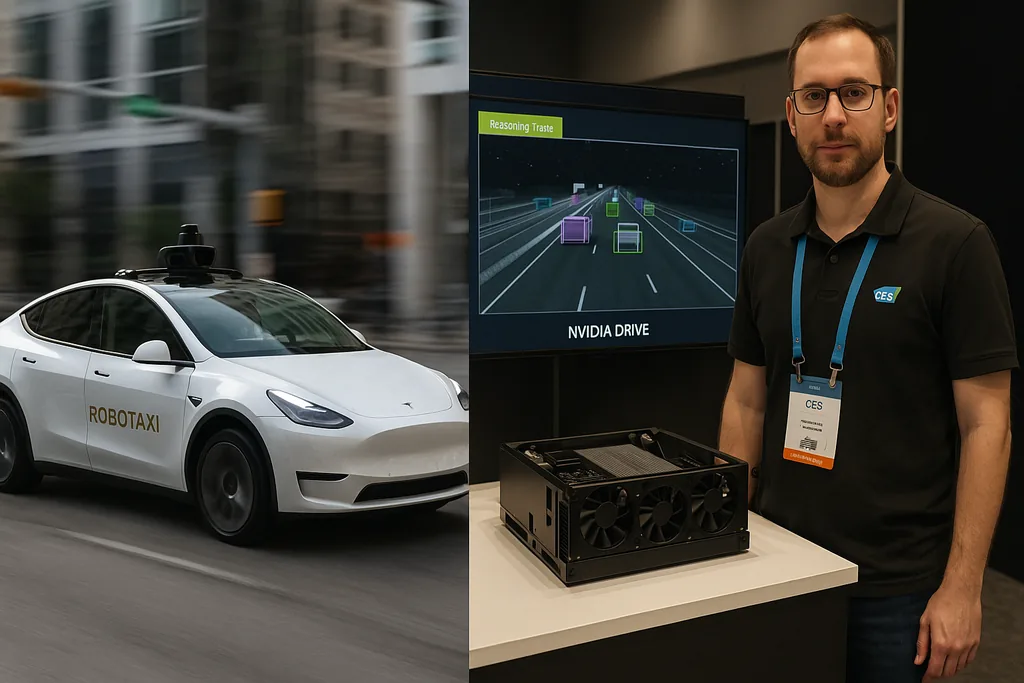
At CES and on Austin streets: two strikingly different blueprints
In early January at the Consumer Electronics Show in Las Vegas, Nvidia unveiled Alpamayo — an open family of large vision-language-action models and accompanying simulation tools designed to teach cars to "reason" about unusual traffic scenes. The company framed the technology as a step-change for what it called "physical AI" and promoted the approach as a teachable, modular platform that automakers can plug into their vehicles.
Half a year earlier, in Austin, Texas, Tesla quietly began letting a small fleet of modified Model Y vehicles carry invited passengers as part of its Robotaxi pilot, a visible demonstration of the company’s decades‑long bet on camera-only, fleet-trained driving software. That rollout — initially limited and monitored — showed a contrasting path: Tesla shipping software inside vehicles it builds and uses to amass real‑world driving experience.
Platform versus product: how the engineering philosophies diverge
Nvidia’s public pitch is platform-first. It sells silicon, middleware, sensor suites and an operating environment (DRIVE Hyperion and DRIVE AGX/Thor), and in January the company highlighted third‑party safety assessments and an ecosystem of automaker partners that can adopt parts of the stack rather than rebuild them from scratch. That model lets legacy automakers and new EV makers accelerate by outsourcing compute and software, while remaining free to choose sensors and vehicle architectures.
Training compute: cloud clusters, open models and the fate of Dojo
Until recently, Tesla had been pursuing a bespoke training path with Dojo — an in‑house supercomputer project billed as the backbone for Full Self‑Driving research and, eventually, humanoid robots. In 2025 Tesla reorganized parts of its compute strategy, and reporting since mid‑2025 has described the Dojo program being wound down as the company shifted toward other chip and cluster plans. That change illustrates a central tension: building a world‑class training supercomputer in private is expensive and slow, while buying or co‑leasing state‑of‑the‑art accelerators can scale faster but cedes some control.
Nvidia’s bet is different: provide the high‑performance compute (its GPUs and DRIVE SoCs) and an open, teacher‑student workflow where a large, reasoning model like Alpamayo can be distilled into smaller runtime networks that run inside a car. The company also announced a suite of simulation tools and open datasets intended to let many players train, test and validate without rebuilding every piece of infrastructure. That approach lowers the barrier for traditional automakers to field advanced driver assistance and, eventually, higher autonomy levels.
Sensors and the long‑tail problem
The two companies also disagree on sensors. Nvidia’s Hyperion reference design explicitly supports multimodal sensor suites — cameras, radar, and increasingly lidar — and the company highlighted partnerships with lidar suppliers at CES and in announcements about the DRIVE Hyperion platform. Nvidia argues that richer sensor fusion helps systems perceive depth and detect hazards in low‑visibility or edge‑case scenarios.
Tesla has doubled down on a camera-first strategy, arguing that human drivers use vision alone and that a well-trained neural network can extract depth and motion from video. The advantage is lower hardware cost and simpler integration, plus massive amounts of in‑service video from Tesla’s fleet that can keep improving models. The downside — raised repeatedly by regulators and safety experts — is uncertainty about rare events and whether vision‑only systems generalize as well as multimodal stacks in unusual circumstances.
Regulation, incidents and public trust
Operational safety and public scrutiny are the crucible for both strategies. Tesla’s FSD and Autopilot systems have been the subject of multiple regulatory inquiries and a sustained dataset of incident reports submitted to the U.S. safety regulator. In 2025 the National Highway Traffic Safety Administration opened a preliminary evaluation covering millions of vehicles after reports of red‑light and lane‑change incidents, highlighting both the legal risks and the political scrutiny that follow early adopter deployments.
Nvidia has emphasized third‑party safety assessments, including engagement with established automotive safety bodies, as part of a package that maps more cleanly to existing regulatory frameworks relied on by automakers. The company’s pitch — certified components, open datasets, and explainable reasoning traces from Alpamayo — is explicitly designed to help OEMs satisfy safety and audit requirements as they scale autonomous features.
Market dynamics and the path to scale
Strategically, Nvidia and Tesla are chasing overlapping end‑goals — large autonomous fleets and robotaxi services — but with different risk/reward profiles. Nvidia sells into an enormous market of carmakers that will likely prefer modular, validated platforms they can integrate into existing production lines; that opens many revenue paths without the capital intensity of building cars or running fleets. Early market reactions to Nvidia’s CES announcements included sharp moves in supplier stocks for lidar and sensor companies, reflecting investor belief that a multi‑vendor, platform approach accelerates ecosystem growth.
Tesla’s upside, if its vertically integrated strategy succeeds, is a unique end‑to‑end product: a car, an operating brain trained on billions of real‑world miles, and the services that monetize those vehicles as robotaxis. But that model concentrates operational, regulatory and reputational risk in one place — and the recent reorganisation of Tesla’s bespoke compute efforts underscores how costly and brittle that path can be.
Convergence, competition and what comes next
Even as the companies differ, their paths may converge. Nvidia’s open teacher‑student route makes it easier for automakers (and perhaps even for Tesla in theory) to adopt reasoning‑based models; Tesla’s massive fleet continues to be a data advantage for end‑to‑end learning. Both camps will be judged not only on the sophistication of their models and silicon, but on real‑world safety, transparent metrics for edge‑case handling, and regulators’ willingness to certify unsupervised operation.
For consumers and cities, the near term will look messy: mixed fleets, patchwork regulation across jurisdictions, and incremental service rollouts with monitors and geofences. For investors and technologists, the question is whether the industry tilts toward modular platforms that make autonomy broadly accessible, or toward a few vertically integrated winners that capture the whole stack. Either way, the race to robotaxis now reads like a multiple‑track contest: one lane stacked with millions of consumer cars collecting data, the other with standardized platforms and open models that promise faster validation and broader adoption.
Sources
- NVIDIA press materials (Alpamayo, DRIVE Hyperion and DRIVE AGX announcements)
- National Highway Traffic Safety Administration (preliminary evaluation and investigation files on advanced driver assistance systems)
- TÜV SÜD and independent automotive safety assessment reports referenced in vendor materials
- Tesla public statements and company filings regarding FSD, Robotaxi pilots and compute strategy