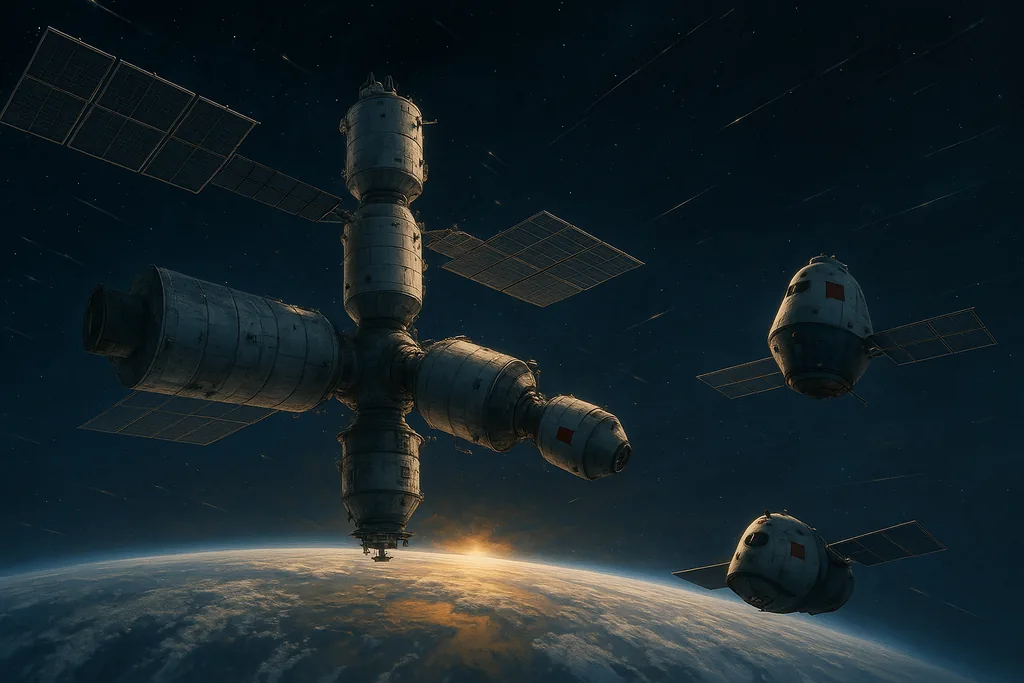
China’s human spaceflight program is facing an unusual operational headache after a suspected piece of orbital debris damaged a docked Shenzhou return capsule, forcing mission controllers to use a newly arrived spacecraft to bring the earlier crew home. That decision has left the fresh crew on the Tiangong space station temporarily without their assigned reentry vehicle.
What happened
The sequence began when the Shenzhou-20 crew, who had been aboard the Tiangong space station since April, were preparing to return to Earth in early November. Routine inspections found small cracks in a viewport on the Shenzhou-20 return capsule — damage officials say is most likely the result of an impact from tiny space debris. Because the capsule no longer met the safety requirements for re-entry, mission controllers delayed the crew’s departure and later brought them home in the capsule that had delivered the next crew, Shenzhou-21. The swap restored the earlier crew to Earth but left the Shenzhou-21 astronauts without their planned ride.
Who is on board and where they are now
The stranded trio — the commander and two crewmates who launched on Oct. 31 as part of the Shenzhou-21 rotation — remain aboard Tiangong and are reported to be healthy and continuing their planned science and maintenance work. China’s space agency has said engineers are working through contingency procedures and that the situation is under control, while a replacement return capsule is being prepared. Tiangong is significantly smaller than the International Space Station but was designed to support crew handovers and short periods with overlapping crews.
How controllers solved the immediate problem
Rather than leave astronauts aboard an impaired capsule, controllers effectively conducted an improvised crew swap: the later-arriving Shenzhou-21 spacecraft remained docked but was used to carry the earlier Shenzhou-20 crew safely back to Earth. That maneuver is technically straightforward because the Shenzhou vehicles are built with an independent reentry module, but it leaves the station populated without a certified, mission-ready return craft for the newer crew. Officials say the damaged Shenzhou-20 hardware will remain in orbit for experiments or be disposed of safely once a replacement arrives.
Rescue plans and a likely timeline
China’s human spaceflight agency has said it will launch a replacement capsule at an appropriate time. Unconfirmed reporting and industry sources suggest an accelerated launch of an uncrewed replacement vehicle could be targeted within days to weeks of the swap; some outlets have mentioned a potential launch window later this month. Until that replacement arrives and docks, mission planners are conducting drills and readiness checks so the station’s crew can return promptly when a certified vehicle is available. Officials emphasize that the crew is not in immediate danger and that the situation is being handled according to contingency plans.
Why a damaged viewport matters
Spacecraft like Shenzhou are divided into separate modules: service and propulsion sections, a habitable orbital module, and a sealed reentry capsule equipped with heatshield and parachute systems. Damage to any part of a craft that affects structural integrity, visibility through a window, or the integrity of seals can undermine confidence in a safe atmospheric reentry. In this case, the cracks were reported in a window, which raised questions about micrometeoroid or debris puncture and prompted a conservative decision to avoid taking crewed reentry in that vehicle. In an emergency, mission planners retain options — for example, they could assess whether the damaged element is isolated from the reentry apparatus — but conservative safety margins generally govern decisions about carrying humans back through reentry.
Broader context: debris, risk and operations
The incident is another reminder of how small fragments of orbital debris can produce outsized disruption. Operators worldwide now track tens of thousands of catalogued objects and rely on collision-avoidance maneuvers for larger threats, but tiny, high-speed fragments remain difficult to detect and can still inflict serious damage on spacecraft surfaces. As more satellites and missions populate low Earth orbit, the frequency of such encounters — and the operational complexity they create — is expected to rise unless debris mitigation and removal efforts scale up. The Chinese case underscores the operational trade-offs national programs face when balancing crew safety, station logistics and launch cadence.
What this means for China’s spaceflight schedule
For now, the affected crew are expected to carry on with their mission tasks while waiting for a replacement return capsule. That could prolong on-orbit overlap between crews or require adjustments to planned launches. China’s program has been expanding its ambitions — including further crew rotations and international participation — and an unexpected hardware issue introduces schedule risk while engineers investigate the damaged vehicle and pursue replacement hardware. The agency’s public statements stress that the situation is under control and that the safety of personnel is the priority.
Why the story matters
Beyond the immediate human story — three astronauts living a little longer in orbit than planned — the episode illustrates the fragility of human missions in crowded orbital environments. It highlights the need for robust contingency hardware, rapid-response launch capabilities, and aggressive debris remediation strategies if crewed operations are to scale sustainably. The way teams respond to this event will also offer lessons about operational resilience that will be relevant to all nations conducting long-duration human spaceflight.
As the replacement capsule is prepared and a new launch date set, mission updates are likely to follow. For now, the priority for controllers is clear: keep the crew safe, preserve station operations, and restore normal crew rotation as soon as it can be done without compromising safety.