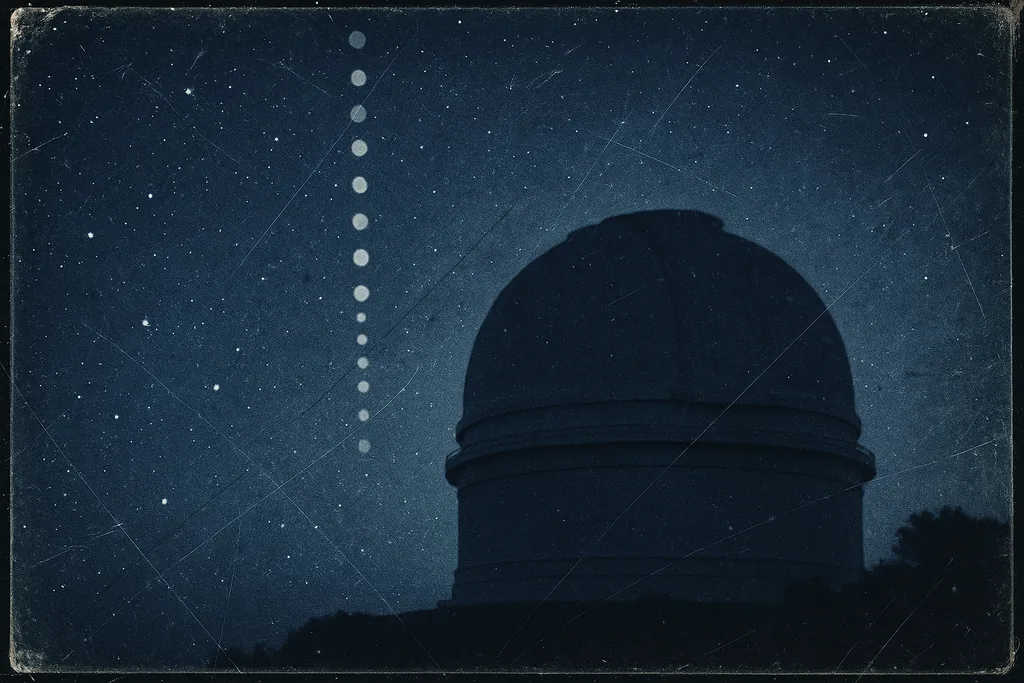
For more than seven decades a few faint, star‑like dots have haunted the margins of astronomical archives. They appear on mid‑20th century photographic plates from the Palomar Observatory, show up in one long exposure and are gone within an hour — long before the launch of the first artificial satellite. This autumn, two companion peer‑reviewed studies re‑examined those archival sky surveys and pushed the puzzle back into the spotlight: the transients are real detections in scanned plate data, and one analysis reports statistical associations with historical nuclear detonations and spikes in contemporary reports of unidentified anomalous phenomena.
Why many astronomers are cautious
Despite the intrigue, a number of astronomers and instrument specialists have urged caution. Photographic glass plates and their later copy sets are delicate, and copying, storage and digitization can introduce blemishes that mimic stellar images. A thorough, independent forensic study published in 2024 examined copy plates and publicly available scans with objective, machine‑learning‑based classifiers and concluded that a large fraction of the apparent transients are likely spurious artifacts of the emulsion or the historical copying process.
Several senior astronomers not involved in the recent pair of papers have pointed out two practical limits. First, the original plate material and the way it was reproduced matter: many digital scans were made from glass copy plates rather than the delicate originals, and copying or contact‑printing steps in the 1950s could imprint small holes, dust patterns, or scratches that register as point‑like defects. Second, observational constraints — plate exposure lengths, guiding and seeing at the time, and the limited ancillary metadata — make it difficult to interpret these detections unambiguously decades later.
What the competing explanations would imply
- Plate artifacts: If copying or emulsion blemishes created the false positives, the story is a cautionary tale about archival data and the need for forensic inspection of originals before drawing physical conclusions.
- Unknown atmospheric or geophysical effects: Nuclear detonations do loft dust, debris and ionising products high into the atmosphere. Some commentators have suggested that fallout, glowing ionised material or short‑lived atmospheric chemistry could make transient glows visible to long‑exposure photographic plates, but proponents of the artifact hypothesis argue such phenomena would usually look diffuse or streaked, not like sharp, stellar point‑spread functions.
- Reflective glints or artificial objects: Another hypothesis is that highly reflective surfaces in orbit produced specular glints that mimicked stars for the duration of the exposure. For this to produce motionless point‑like images on half‑hour plates, objects would either need to be at unusually large distances or to have very particular trajectories. That raises engineering and provenance questions if such objects had been in orbit before Sputnik.
- Gravitational lensing or background flashes: Some researchers have entertained more exotic astrophysical scenarios, such as brief flashes in distant objects combined with specific lensing configurations that could create multiple, closely spaced images. These models typically require a population of massive lensing structures and are regarded as speculative.
How the field moves forward
Scientists who have examined the debate converge on one practical path: direct, independent forensics. That means locating and inspecting the original POSS‑I negatives and the first‑generation contact prints under magnification, rescanning them at the highest practical resolution, and comparing plates and copies field by field. Microscopic inspection can reveal whether a candidate transient is truly recorded on the original emulsion or is introduced in later copying or scanning. Complementary work includes checking the same sky fields in plates from other observatories, reprocessing the digitized scans with different algorithms, and applying blind statistical tests that account for plate defects and cataloguing biases.
Equally important is the contextual evidence. The statistical association with above‑ground nuclear tests and with historical UAP reports is intriguing but hinges on the quality and independence of the records being compared. Historical eyewitness reports are anecdotal and clustered in time and place for many social and cultural reasons; they are weak anchors for causal claims unless tied to independent physical traces.
Why this matters beyond UFO headlines
At stake is an object lesson in modern science: archival data can contain genuine surprises, but older datasets carry their own instrument‑specific pathologies that must be disentangled. If a subset of these transients survives rigorous forensic inspection as genuine above‑atmosphere flashes, they would open a new empirical problem demanding physical explanation. If they are artifacts, the episode is a reminder to ground bold interpretations in microscopic evidence and multiple, independent lines of verification.
For now, the Palomar transients remain an open question — a mixture of careful detective work, archival forensics and statistical detective work that will require cooperation between plate curators, instrument specialists and observers. The debate has moved from fringe speculation toward mainstream methods: publish, test, and reproduce. That is how an apparently 70‑year‑old mystery will be settled — not by insistence on a single narrative, but by that patient, sometimes slow, work of science.
The curtain is still up on the mid‑century sky. The next act will depend on whether the originals reveal blemishes or genuine flashes when examined with modern tools, and whether independent observatories find the same signature in their archives. Until then, there really is no easy explanation.