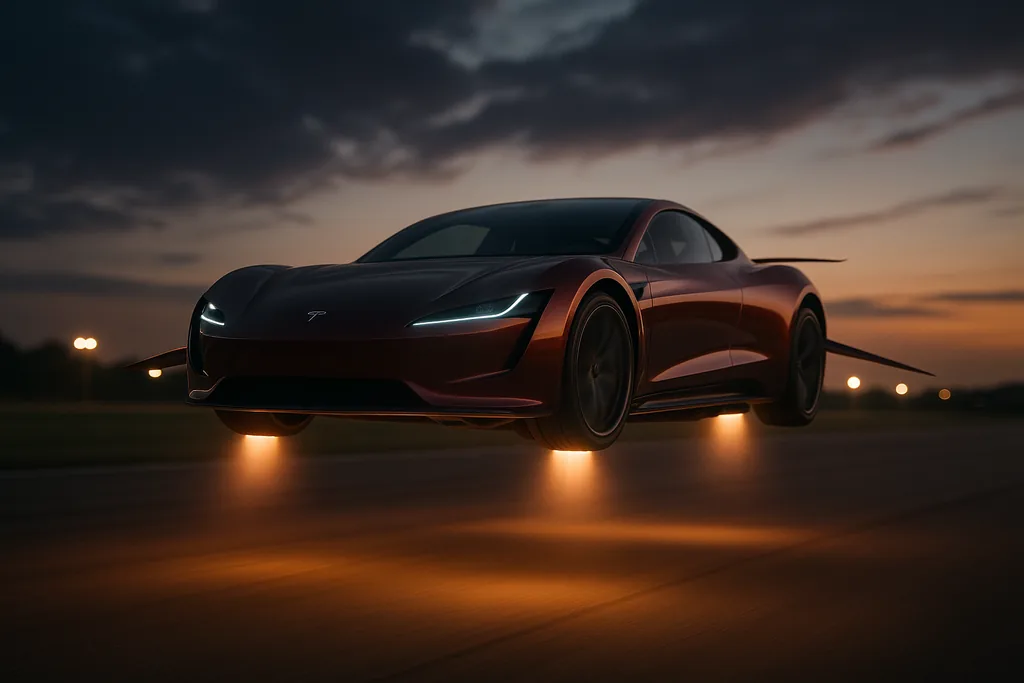
What did Musk say — and why it matters
Elon Musk told podcast host Joe Rogan this autumn that Tesla is “getting close” to demonstrating a prototype whose product reveal will be “unforgettable,” and he repeatedly described the vehicle as packing “crazy, crazy” technology. He suggested the demo could happen before the end of the year and teased that the project might answer a long-standing complaint about modern life: where are the flying cars?
History: the Roadster, the SpaceX package and long delays
The comments revived speculation about Tesla’s long‑promised second‑generation Roadster, which was first shown in 2017 with headline performance claims and an optional "SpaceX package" featuring cold‑gas thrusters. That package was described at the time as a way to boost acceleration and, in Musk’s more dramatic phrasing, even enable brief hovering. The car has been delayed repeatedly since its unveiling and has become emblematic of Tesla announcements that arrive long after initial timelines.
Flying — what might Musk actually mean?
There are important distinctions between a car that can briefly hover, and a certified aircraft that carries passengers on routine flights. Musk’s past references to cold‑gas thrusters indicate a path toward short, demonstrable vertical force — think a brief hop or enhanced downforce rather than sustained, piloted flight like an airplane. A public demo that looks like "flying" could therefore be a controlled hover or a cinematic stunt rather than a production‑ready vertical takeoff and landing (VTOL) vehicle.
Two technical paths
- Rocket or thruster‑based lift: Short bursts of thrust can shift downforce or briefly lift a car, but they bring issues of control, propulsion storage, and safety; those systems are heavy, need pressurized stores or propellants, and must meet vehicle crash and hazardous‑materials rules.
- eVTOL rotors/wings: Electric vertical‑takeoff solutions use distributed rotors or ducted fans to lift the aircraft. They require a distinct airframe, redundancy for motor failures, thermal and battery management, and a certification pathway that treats the vehicle as an aircraft rather than a car.
Regulatory and practical hurdles
Even if the technology demonstrator flies or hovers, scaling that into a usable product faces steep regulatory headwinds. Aviation authorities are still building certification frameworks for electric VTOLs, and no eVTOL had full type certification as the sector matured through 2024–2025. Beyond the aircraft itself, cities need vertiports, air‑traffic integration for low‑altitude corridors, pilot training or autonomous‑flight approvals, and community buy‑in around noise and safety. These are not overnight fixes.
Who else is building 'flying cars'?
Around the world a cluster of companies are pursuing what the industry calls advanced air mobility: electric air taxis and smaller VTOL craft designed for short urban hops. Some firms have advanced deep into FAA testing and are working on Type Inspection Authorization steps, while others are building regional partnerships and vertiport pilots. That industry progress highlights a key point: mature, quiet, certified passenger eVTOLs are being developed, but they follow aerospace workflows, not automotive ones.
Read the tea leaves — hype, history and incentives
Musk’s public statements have often moved markets and expectations. Tesla has a track record of headline‑grabbing promises that subsequently shift timelines; the Roadster itself is a notable example of a product announced years before production. That pattern doesn’t mean a demo won’t happen — it simply raises the need to separate theatrical reveals from deliverable, certified products that ordinary buyers can safely use. Some early customers and even well‑known depositors have publicly canceled orders after long waits, reflecting impatience with stretched schedules.
Why a demo would still be consequential
What to watch next
- Will Tesla actually stage a public prototype demo, and if so, what will “flying” look like in that footage?
- Will regulators require the event to be constrained or pre‑cleared given the public safety implications?
- Will Tesla describe a roadmap from demo to certification, or treat the reveal as a one‑off showcase?
- How will incumbent eVTOL companies and aviation regulators react to a major automaker stepping into the low‑altitude arena?
Elon Musk’s tease is exciting and evocative, but the road from a headline‑worthy demo to a safe, certified product that can be bought, insured and operated in cities is long and complex. For now, the sensible stance is curiosity coupled with technical skepticism: watch the demo, scrutinize the engineering details, and measure any claims against aviation rules and safety practice rather than theatrical promise.
— Mattias Risberg, Dark Matter. Based in Cologne, covering semiconductors, space policy and the intersection of hardware and public policy.