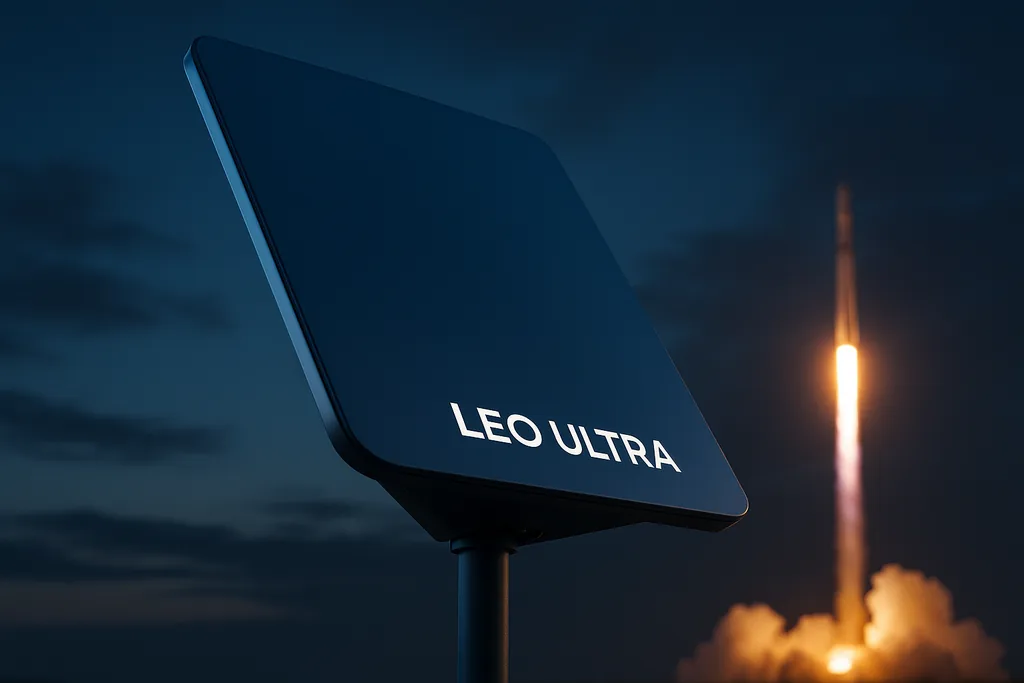
“We built the antenna for people who can’t afford downtime.”
Why it matters: Amazon Leo shifts the competition from consumer convenience to guaranteed infrastructure. That matters for hospitals, airlines, energy firms, telecom operators and defence contractors who need predictable throughput and a clear route into cloud services. It also puts Jeff Bezos in a much closer race with Elon Musk’s Starlink — and illustrates one of the strangest strategic ironies in modern space commerce: Bezos’s company is paying Musk’s for rides into the very orbit where they will compete.
A hardware push with cloud strings attached
Amazon’s reveal centers on terminal hardware as much as satellites. Leo Ultra, together with a smaller Leo Pro and a pocket-size Leo Nano, is presented as part of a package that plugs directly into Amazon’s cloud ecosystem. The seller pitch is explicit: not just broadband but a clean, private pipeline into Amazon Web Services. For enterprise customers that already run back-end systems on that cloud, that promise is the differentiator Amazon is banking on.
Friendship with the enemy
Perhaps the most striking detail in Amazon’s rollout is how the satellites have been getting into orbit. Despite public barbs and a long-running billionaire rivalry, Amazon has purchased launch capacity from SpaceX and other providers. That’s not just pragmatic purchasing — it’s a public demonstration that commercial rivalry and supplier pragmatism can coexist. Executives involved in the project have even thanked SpaceX after missions that deployed Kuiper hardware.
The optics are awkward. Elon Musk has not been shy about taunting political figures and competitors in public forums; one widely reported exchange in 2025 underlined how politically charged access to satellite service can become. Yet Amazon, which lacks its own operational heavy-lift launch cadence, is making commercial trade-offs to meet tight deployment targets. That tension — a rivalry played out both in boardrooms and on launch manifests — frames much of the drama around Leo’s emergence.
Deadlines, numbers and the pressure cooker
Amazon’s constellation is still tiny compared with Starlink’s fleet. The company has launched several dozen operational Kuiper satellites and says it will eventually field more than 3,200 to achieve global coverage. But federal filing deadlines and spectrum licences impose hard milestones — including a requirement to place a large fraction of its planned constellation into orbit by mid-2026. That timetable helps explain some of the company’s aggressive procurement decisions and why it is willing to depend on multiple launch partners.
The financial math compounds the strain. Estimates of the full programme’s cost run into the tens of billions once manufacturing, launches, ground infrastructure and terminal subsidies are included. Those costs will shape Amazon’s commercial choices: who it sells to first, how much it offsets terminal prices, and whether it leans on partners — including national telcos and governments — to shoulder deployment and distribution risks.
Claims versus reach
Amazon’s marketing emphasizes secure, high-throughput links and a differentiated enterprise service. Independent observers — and competing operators — will test those claims in the months after initial service turn-on. The proof points will be simple and unforgiving: latency across hostile routes, the resilience of direct cloud connections, and how the network behaves when satellites and beams are in high demand. Early demos can show raw speed; sustained SLAs and roaming agreements will determine whether customers migrate from incumbent terrestrial providers and from Starlink.
Regulatory and geopolitical complications
Satellite broadband is not a neutral utility; it sits at the intersection of telecom regulation, export controls and national security policy. Governments that once relied on a single supplier may view Amazon as an alternate vendor for critical links, but they will also demand rules for encryption, access control, and on-orbit behaviour. Those demands can slow rollouts and shape commercial contracts, especially where military or emergency communications are involved. The move by operators to tout private networking and direct cloud access also raises fresh questions about data sovereignty and lawful intercept.
What the rivalry might actually look like
For consumers, the battle will be measured in terminal price, coverage maps and customer service experiences. For enterprise customers, it will be decided on SLAs, latency guarantees, and integration into existing operations. SpaceX’s early mover advantage and its vertically integrated stack — builds its own satellites, launches them on its rockets, and sells the terminals — is a stiff headwind. Amazon’s counter is a different kind of verticality: cloud integration, distribution networks, and enterprise sales channels that can bundle connectivity with compute. Whether that is enough to carve out a meaningful share depends on execution, economics, and how fast Amazon can spin up launches and ground infrastructure.
Small man, big orbit
Jeff Bezos and Elon Musk both know how to play long games. The current phase is less about immediate consumer conquest and more about positioning — proving the technology, signing anchor partners, and smoothing the path for mass deployments. For Amazon, the next few quarters will be a crucible: service tests, more launches, and early enterprise deals that either validate the Leo thesis or expose the limits of a late entrant into a winner-takes-most market. Either way, the spectacle of Bezos buying launch slots from Musk while preparing to compete against him adds a new, surprisingly human layer to what had been framed as a billionaire duel in space.
James Lawson is an investigative reporter at Dark Matter, covering commercial space, AI and tech policy from the UK. This story draws on company briefings, launch manifest updates and public filings as the Amazon Leo service approaches its first customer deployments.